Agent Router: A K8s Native AI Gateway (Part 2)
This article is fully human written. No LLM was used to generate any of the text.
This is a two-part series. Part one (the previous article) shows how to install Agent Router. Part two (this article) shows how to deploy a production-ready AI gateway with it.
Agent Router (formerly Envoy AI Gateway) is a K8s operator for deploying fully fledged AI/LLM gateways. It is built on Envoy Gateway, the official K8s Gateway API implementation for Envoy.
Goal
We are going to use Agent Router CRDs (Custom Resource Definitions) to deploy a production-ready gateway with:
- Automatic fallback to backup providers.
- API keys with custom budgets.
- Grafana usage dashboard.

All of this is wired together purely with K8s Custom Resources, referencing each other through annotations and targetRefs/backendRefs.
Here is the full resource graph we are about to build, section by section:

Using CRDs for defining everything is super useful for two main reasons:
- It reduces drift, as there is a controller which constantly reconciles live state.
- It allows creating app-specific resources like API keys inside the helm chart which deploys our application to K8s (without needing to run terraform to create these resources on the side).
Prerequesites
You’ll need a K8s cluster with the following operators installed:
- Agent Router with the configuration from part one.
- External Secrets Operator, for generating random API keys.
- cert-manager, for issuing TLS certificates for the gateway.
- Prometheus operator, for scarping metrics from the gateway.
- Grafana, for creating the dashboard.
Creating A Gateway
A standard Gateway resource is used to create an Envoy gateway. The CRDs in the next sections are used to configure it.
apiVersion: gateway.networking.k8s.io/v1
kind: Gateway
metadata:
  name: gateway
  namespace: ai-gateway
  annotations:
    cert-manager.io/cluster-issuer: letsencrypt
    aigateway.envoyproxy.io/gateway-config: gateway-config
spec:
  gatewayClassName: envoy
  listeners:
    - name: https
      hostname: ai.lab.linuxdweller.com
      protocol: HTTPS
      port: 443
      tls:
        mode: Terminate
        certificateRefs:
          - group: ""
            kind: Secret
            name: gateway-tls
      allowedRoutes:
        namespaces:
          from: All
TLS is handled by cert-manager, which creates the tls.certificateRefs secret automatically.
The aigateway.envoyproxy.io/gateway-config annotation points at a GatewayConfig resource. It defines
cost and usage metadata keys which are used for calculating budget quotas and Prometheus metrics:
apiVersion: aigateway.envoyproxy.io/v1alpha1
kind: GatewayConfig
metadata:
  name: gateway-config
  namespace: ai-gateway
spec:
  globalLLMRequestCosts:
    - metadataKey: llm_input_token
      type: InputToken
    - metadataKey: llm_cached_input_token
      type: CachedInputToken
    - metadataKey: llm_output_token
      type: OutputToken
    - metadataKey: llm_total_token
      type: TotalToken
    - metadataKey: llm_cost_microusd
      type: CEL
      cel: >-
        (model == "gemini-3.1-flash-lite") ?
          int(double(input_tokens - cached_input_tokens) * 0.25 + double(cached_input_tokens) * 0.025 + double(cache_creation_input_tokens) * 0.08333 + double(output_tokens + reasoning_tokens) * 1.5)
        : (model == "deepseek-flash") ?
          int(double(input_tokens - cached_input_tokens) * 0.3 + double(cached_input_tokens) * 0.006 + double(cache_creation_input_tokens) * 0.3 + double(output_tokens + reasoning_tokens) * 1.2)
        : int(double(total_tokens) * 10.0)
llm_cost_microusd is a CEL expression which calculates the cost per request in micro-dollars.
Defining Routes With Fallback
We define a backend by creating a group of Backend, BackendTLSPolicy and AIServiceBackend
resources.
In this example we define api.deepseek.com as the actual backend.
apiVersion: gateway.envoyproxy.io/v1alpha1
kind: Backend
metadata:
  name: deepseek
  namespace: ai-gateway
spec:
  endpoints:
    - fqdn:
        hostname: api.deepseek.com
port: 443apiVersion: gateway.networking.k8s.io/v1alpha3
kind: BackendTLSPolicy
metadata:
name: deepseek-tls
namespace: ai-gateway
spec:
targetRefs:
- group: gateway.envoyproxy.io
kind: Backend
name: deepseek
validation:
wellKnownCACertificates: System
hostname: api.deepseek.comapiVersion: aigateway.envoyproxy.io/v1beta1
kind: AIServiceBackend
metadata:
name: deepseek
namespace: ai-gateway
spec:
schema:
name: OpenAI
backendRef:
name: deepseek
kind: Backend
group: gateway.envoyproxy.ioBackendis a custom Envoy Gateway CRD which is used to route traffic to a backend which is not a K8s service.BackendTLSPolicyis a standard Gateway API CRD which is required to communicate with a backend over HTTPS.AIServiceBackendis an Agent Router CRD which specifies our backend is using an OpenAI-compatible schema.
Finally, an AIGatewayRoute is used to tie everything together. It defines routes to specific models
(deepseek-v4-pro and deepseek-flash in this case) with fallback to other models/backends (gemini-3.1-flash-lite):
apiVersion: aigateway.envoyproxy.io/v1beta1
kind: AIGatewayRoute
metadata:
  name: models
  namespace: ai-gateway
spec:
  parentRefs:
    - name: gateway
      kind: Gateway
      group: gateway.networking.k8s.io
  hostnames:
    - ai.lab.linuxdweller.com
  rules:
    - matches:
        - headers:
            - type: Exact
              name: x-ai-eg-model
              value: deepseek-flash
      backendRefs:
        # Main.
        - name: deepseek
          modelNameOverride: deepseek-flash
          priority: 0
          weight: 1
        # Fallback.
        - name: gemini
          modelNameOverride: gemini-3.1-flash-lite
          priority: 1
          weight: 1
      modelsOwnedBy: Envoy AI Gateway
In this example, deepseek-flash has a fallback to gemini-3.1-flash-lite. Gemini also has an AIServiceBackend which is ommited for brevity as it matches the deepseek one.
x-ai-eg-model is populated automatically by Agent Router with the model name the client specified in the
request body.
Creating API Keys
First, we generate a swe-bench-token Secret with a random 48 character token using External Secrets Operator Password and ExternalSecret resources:
apiVersion: generators.external-secrets.io/v1alpha1
kind: Password
metadata:
  name: swe-bench-token
  namespace: ai-gateway
spec:
  length: 48
  symbols: 0
  allowRepeat: true
  secretKeys:
- swe-benchapiVersion: external-secrets.io/v1
kind: ExternalSecret
metadata:
name: swe-bench-token
namespace: ai-gateway
spec:
refreshInterval: "0"
target:
name: swe-bench-token
dataFrom:
- sourceRef:
generatorRef:
apiVersion: generators.external-secrets.io/v1alpha1
kind: Password
name: swe-bench-tokenThen, we allow the swe-bench-token Secret to make API requests using a SecurityPolicy (custom Envoy Gateway CRD):
apiVersion: gateway.envoyproxy.io/v1alpha1
kind: SecurityPolicy
metadata:
  name: opencode-consumer-auth
  namespace: ai-gateway
spec:
  targetRefs:
    - group: gateway.networking.k8s.io
      kind: HTTPRoute
      name: models
  apiKeyAuth:
    forwardClientIDHeader: x-llm-client-id
    credentialRefs:
      - group: ""
        kind: Secret
        name: swe-bench-token
    extractFrom:
      - headers:
          - Authorization
Defining Budget Quotas
Using a BackendTrafficPolicy (custom Envoy Gateway CRD) we define a custom budget quota:
apiVersion: gateway.envoyproxy.io/v1alpha1
kind: BackendTrafficPolicy
metadata:
  name: gemini-token-ratelimit-policy
  namespace: ai-gateway
spec:
  targetRefs:
    - group: gateway.networking.k8s.io
      kind: Gateway
      name: gateway
  connection:
    bufferLimit: 10Mi
  timeout:
    tcp:
      connectTimeout: 2s
  rateLimit:
    type: Global
    global:
      rules:
        - clientSelectors:
            - headers:
                - name: x-api-key
                  type: Distinct
                  invert: false
          limit:
            requests: 50000000 # = $50.00/day
            unit: Day
          cost:
            request:
              from: Number
              number: 0
            response:
              from: Metadata
              metadata:
                namespace: io.envoy.ai_gateway
                key: llm_cost_microusd
        - clientSelectors:
            - headers:
                - name: x-api-key
                  type: Distinct
                  invert: false
          limit:
            requests: 100000000
            unit: Day
          cost:
            request:
              from: Number
              number: 0
            response:
              from: Metadata
              metadata:
                namespace: io.envoy.ai_gateway
                key: llm_total_token
  retry:
    numAttemptsPerPriority: 1
    numRetries: 3
    perRetry:
      backOff:
        baseInterval: 100ms
        maxInterval: 2s
      timeout: 3s
    retryOn:
      httpStatusCodes:
        - 429
        - 500
      triggers:
        - connect-failure
        - retriable-status-codes
We are actually configuring two different quota rules:
- 50$ per day for each API key.
- 100M max total tokens (input and output) per day for each API key.
The first quota rule to hit will cause a client to receieve 429 responses.
Scraping Prometheus Metrics
Agent Router metrics are scraped with this PodMonitor which targets the aigw-admin port on the Envoy pod.
Behind this port sits the Agent Router sidecar.
apiVersion: monitoring.coreos.com/v1
kind: PodMonitor
metadata:
  name: ai-gateway-extproc
  namespace: ai-gateway
spec:
  namespaceSelector:
    any: true
  selector:
    matchLabels:
      app.kubernetes.io/name: envoy
      app.kubernetes.io/component: proxy
  podMetricsEndpoints:
    - port: aigw-admin
      path: /metrics
      interval: 30s
The following metrics are available as histograms:
gen_ai_client_token_usage: input/output/cached/rasoning token usage.gen_ai_server_request_duration_seconds: total request latency.gen_ai_server_time_per_output_token_seconds: output tokens/s.gen_ai_server_time_to_first_token_seconds: first output token latency.
Creating A Grafana Dashboard
I took a screenshot of the dashboard after making requests with two API keys, swe-bench and agent-sandbox, to the models deepseek-v4-flash-0731 and qwen3.8-flash.
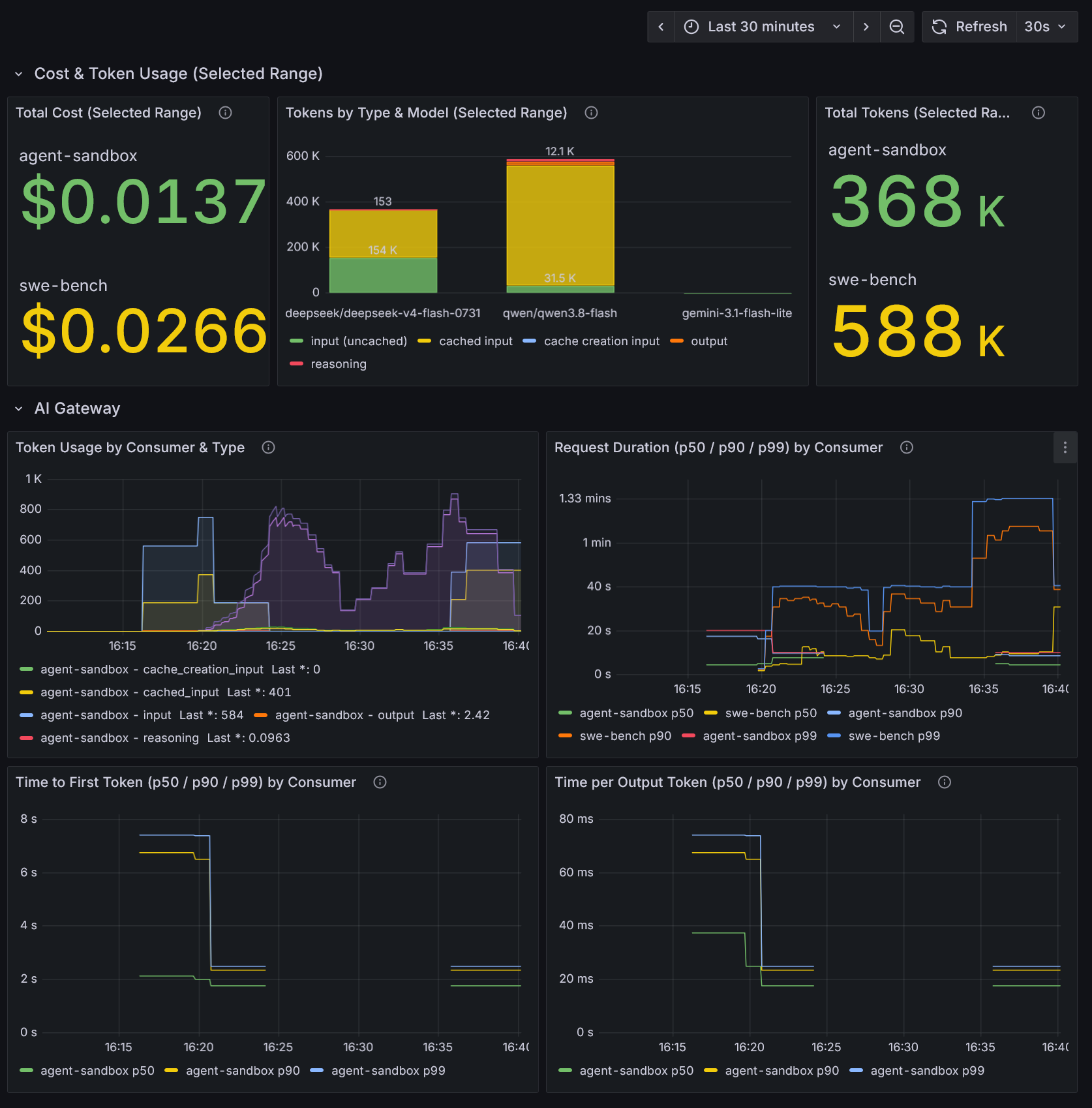
The dashboard’s json definition is available here. It uses all Agent Router metrics to display:
Tokens by Type & Model: input, cached, output and reasoning token count per model.Total Cost: cost per API key.Total Tokens: total tokens (input and output) per API key.Request Duration: request latency.Time per Output Token: output tokens/s.Time to First Token: first token latency per API key.
Result
Our gateway is fully provisioned using K8s CRDs. It is ready to use, with full observability and custom rate limiting in place.
This is an example v1/chat/completions (openai-compatible) request to the deepseek-flash model we confiugred:
export SWE_BENCH_TOKEN=$(kubectl get secret -n ai-gateway swe-bench-token -o json | jq -r '.data["swe-bench"]' | base64 -d)
curl https://ai.lab.linuxdweller.com/v1/chat/completions \
  -H "Authorization: Bearer ${SWE_BENCH_TOKEN}" \
  -H "Content-Type: application/json" \
  -d '{"model":"deepseek-flash","messages":[{"role":"user","content":"say OK"}],"max_tokens":5}'
Tradeoffs
We managed to configure a production-grade AI gateway entirely with CRDs. We also used a completely open solution which has no features gated behind an enterprise contract.
As an avid K8s user, I consider that a great success.
Still, there are several things to consider before deploying Agent Router to production:
- It requires installing 4 different Helm charts for two different operators (see part 1).
- It is still in beta, with new features and bug fixes coming every month.
- It does not have cool cutting-edge capabilities like LiteLLM’s auto-router.
Even if you are not going to deploy Agent Router, I think it is interesting to keep paying attention to it, as it has the potential to become one of the top options to provision AI gateways on K8s.